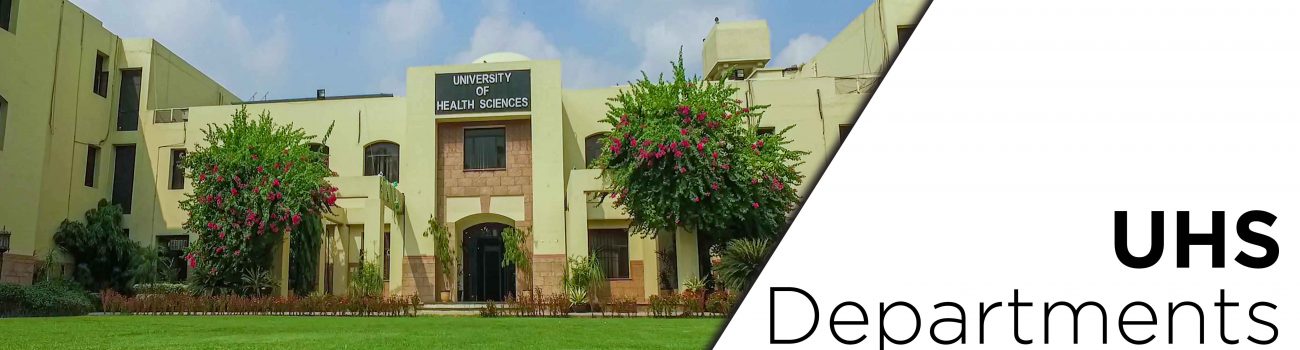
Introduction
The Department of Histopathology at the University of Health Sciences (UHS) was formally established in 2003. Situated in the South Wing of the main university building, the department is located on the ground floor, offering convenient access to students, faculty, and researchers. Since its inception, the department has remained committed to providing high-quality education, training, and research opportunities in the field of Histopathology & Cytopathology. The laboratory is well-equipped with state-of-the-art facilities to support both academic and clinical research activities. It has been carefully designed to cater to the training and educational needs of students pursuing higher academic qualifications, including Ph.D. and M.Phil. in Histopathology & M.Phil. in Medical Laboratory Sciences (MLS). Additionally, the department plays a significant role in supporting the training requirements of M.Sc. Nursing and undergraduate Allied Health Sciences students. With a strong emphasis on academic excellence and innovation, the department provides a conducive environment for learning and research, thereby contributing significantly to the broader objectives of the University of Health Sciences. As a core component of the Department of Pathology, the Histopathology unit aligns itself with the overall vision of UHS — to establish itself as a Centre of Excellence in teaching, learning, and research within the pathological sciences. The field of Histopathology, which focuses on the microscopic examination of tissue to study the manifestations of disease, is crucial to the advancement of medical knowledge and clinical diagnosis. Despite the many breakthroughs in modern medicine over the past few decades, many diseases still pose significant challenges to healthcare professionals around the world. Understanding disease mechanisms at the tissue and molecular levels is essential for developing better diagnostic tools, more effective treatments, and, ultimately, preventive strategies. The department’s faculty comprises highly qualified professionals who are dedicated to mentoring students and guiding their research efforts. In addition to imparting theoretical knowledge, the department emphasizes hands-on laboratory training, critical thinking, and scientific writing — all essential skills for a successful career in academia, clinical diagnostics, or the pharmaceutical and biomedical industries. One of the primary missions of the Department of Histopathology is to produce Ph.D. scholars of international caliber who can compete globally and contribute to the scientific community at large. The department aspires to nurture a new generation of researchers and educators who not only meet but exceed the standards set by foreign universities. Through collaborations, international partnerships, and adherence to the highest academic and ethical standards, the department continually works towards bridging the gap between local expertise and global excellence.
Mission Statement:
The Department of Histopathology aims to deliver high-quality patient-centered knowledge and training of healthcare professionals with delivery of new scientific knowledge and its translation into clinical practice.Vision Statement:
Our vision is to establish the Department of Histopathology as a nationally and internationally recognized center for excellence in scientific research, academic advancement, diagnostic precision, and clinical innovation. We strive to contribute significantly to the evolving field of pathological sciences through innovation, collaboration, and high-quality training.Programs Offered
Duration: 2 Years
The program provides advanced training in diagnostic Histopathology, surgical pathology, and research methodology. The curriculum begins with General Pathology and progresses to Systemic Pathology covering all major organ systems.
Students gain hands-on expertise in gross examination, tissue processing, staining methods (H&E, special stains, immunohistochemistry), and diagnostic reporting under supervision.
In the third semester, emphasis shifts to research and thesis writing. Assessment includes MCQs, SEQs, viva, practical exams, and final thesis defense.
Duration: 2 Years
This program integrates theoretical knowledge with laboratory skills in tissue processing and diagnostic lab technology.
Students study microtechniques (fixation, embedding, staining), microscopy (light, fluorescence, electron), and quality control protocols.
Final semesters focus on research thesis, data analysis, and manuscript writing. Assessment includes written exams, practicals, viva, and thesis defense.
Duration: 2 Years
This program combines coursework, lab training, and research in cytotechnology. Students learn cytology anatomy, sample preparation, and staining techniques like Papanicolaou and Giemsa.
Hands-on training includes slide screening, identifying abnormal cells, and diagnostic reporting.
A major component is thesis research including methodology, data analysis, and defense. Assessment includes exams, practicals, and viva.
Duration: 3 Years
This is an advanced research-based program focusing on Histopathology, Cytopathology, Molecular Pathology, and diagnostics.
Students develop expertise in research design, biostatistics, scientific writing, and laboratory management.
The program emphasizes original research, publications, teaching, and thesis defense, preparing graduates for academic and leadership roles.


